
I want to incorporate daily, or at least regular, content on this blog for the upcoming 2025 season. I thought about recaps, but I feel like Royals fans are likelier to go elsewhere for those (such as Royals Review, Farm to Fountains, or the team site).
Two years back, I introduced a “Three-Star” system for players (based on the hockey Three-Stars system). However, that got a bit overwhelming, especially when evaluating all players for that particular game.
There is some merit to the “Three Stars” system, but I wanted to simplify things to ensure that I could post this series daily or at least regularly (every couple of games). Thus, with the help of TJ Stats apps (subscribe to the Patreon for chrissakes), I am going to do a “Three-Star” pitch plot analysis where I recognize three pitchers who sported the best stuff from a game (or period of games), via the pitch movement metrics.
Thomas Nestico has made his Pitch Plot app free during Spring Training. That can be found here.
The whole point of these posts is to look at processes rather than results. I’ll still talk about the results, but what determines “stars” for pitchers is how their pitches fared on a TJ Stuff+ and/or movement end for that particular game. I think learning more about pitching “processes” will help us determine which Royals pitchers are legitimate and which ones may be just getting “lucky” over a period of time.
With the three-star system, it goes inversely, with one-star being the most standout and three-stars being the least of the awards trio.
Let’s look at the three-star pitchers from the Royals’ February 22nd (against the Dodgers) and 23rd (against the White Sox) Cactus League games. All three pitchers are trying to earn spots in some fashion this spring in Arizona, with one trying to earn a spot in the rotation and the two other relievers trying to make the 26-man roster on Opening Day.
One Star: Kris Bubic (2 IP, 2 H, 1 R, 1 ER, 0 BB, 2 K, 0 HR)-Feb. 23
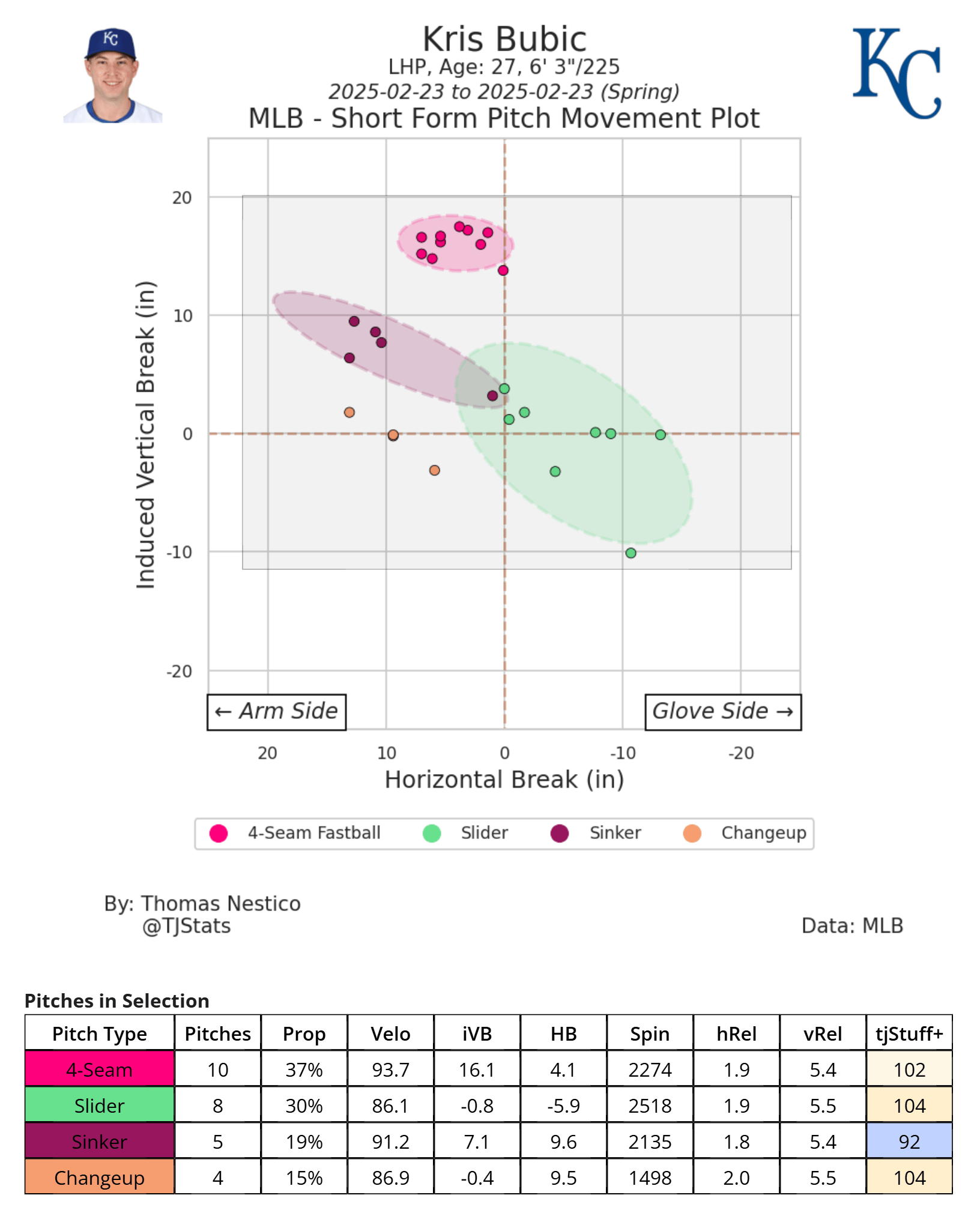
Bubic started on Sunday against the White Sox, and the arsenal played well in his 2025 Cactus League debut. His four-seamer velocity averaged 93.7 MPH, and he sported a tjStuff+ of 102 on his primary fastball pitch. Even though the velocity wasn’t elite, it still was good enough for a starter, and he sported excellent induced Vertical Break (iVB) and spin on the pitch against the White Sox.
Three of his four pitches sported well above-average tjStuff+ metrics, with his slider and changeup having 104 marks. The sinker was a bit below average at 92, but it was used more as a complementary pitch at 19%. The sinker will be interesting to watch as it possesses considerably more horizontal break and less vertical break than his four-seamer. However, it could blend well with his changeup, especially since they share the same HB profile.
The sinker-change combo could be a nice pair against right-handed hitters in the future, with the slider being that put-away pitch that can work against both left-handed and right-handed hitters.
Two Stars: Jonathan Bowlan (1 IP, 0 H, 0 R, 0 ER, 1 BB, 2 K)-Feb. 22
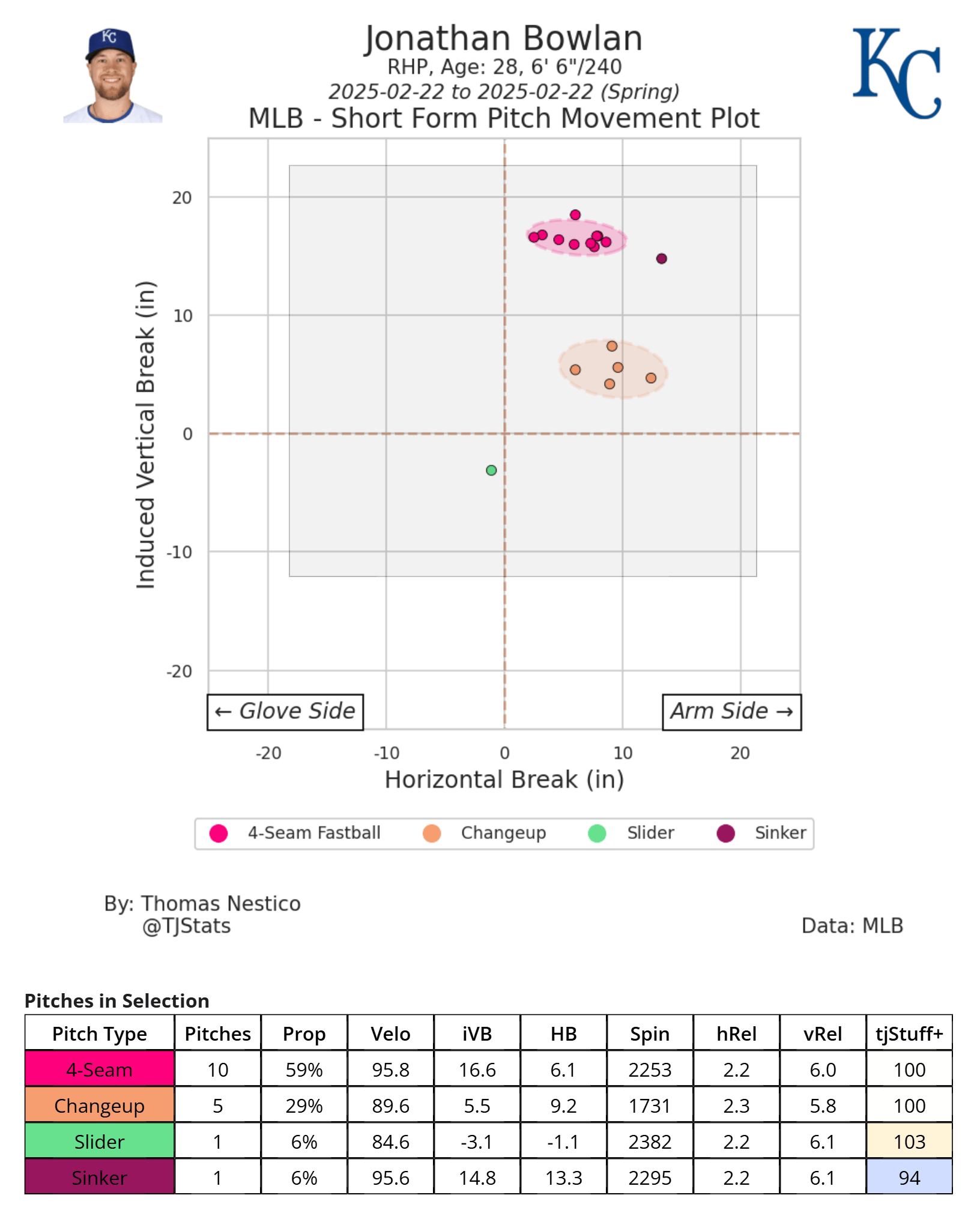
Bowlan showed some excellent movement in his Cactus League debut. Three of his pitches sported tjStuff+ numbers of 100 or higher, including his slider, which has a 103 tjStuff+. He primarily relied on his four-seamer on Saturday, throwing it 59% of the time against the Dodgers. It not only sported good iVB (16.6) but good velocity (95.8 MPH) and spin (2,253 RPM). That kind of fastball profile can transition to the bullpen, a role that he will be primarily moving to in 2025, according to MLB.com write Anne Rogers.
I’ve been a big fan of Bowlan for a while, and it feels like he may take that next step in 2025 after not having a role the last two seasons. Royals fans should keep an eye on his four-seam velocity this spring, for if it continues to rise, it could make Carlos Hernandez expendable (he is out of Minor League options).
Three Stars: Thomas Hatch (2 IP, 0 H, 0 R, 0 ER, 0 BB, 3 K)-Feb. 23
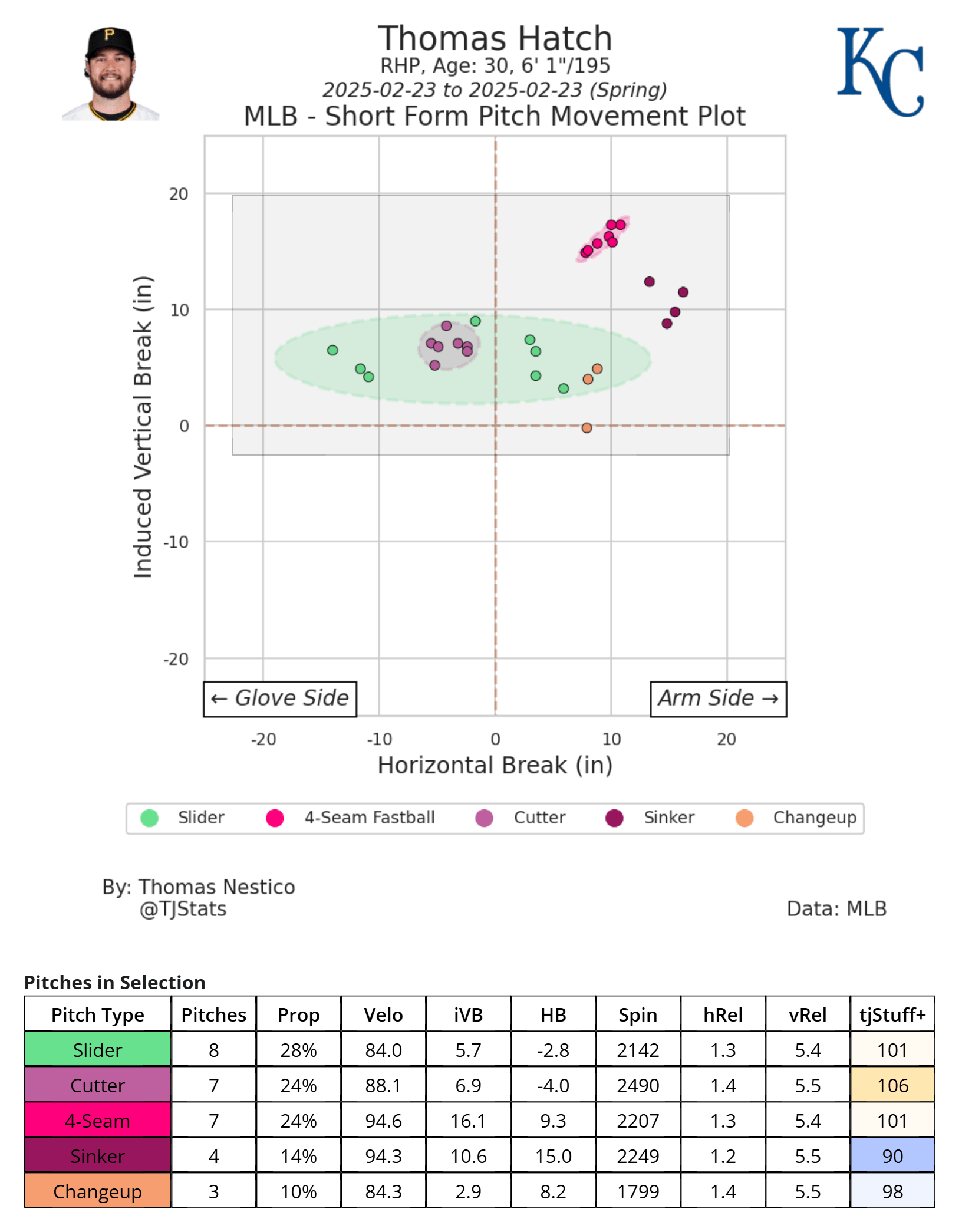
Hatch went under the radar when he signed a Minor League deal this offseason, mostly because he pitched last season in Japan. However, the former Blue Jay and Pirate reliever showed great promise with his pitch quality on Saturday against the White Sox.
The 30-year-old righty threw 29 pitches in two innings of work on Sunday afternoon. He sported three pitches with tjStuff+ marks over 100, with his best offering being his cutter, which had a 106 tjStuff+. The cutter is an interesting pitch with a high spin rate (2,490 RPM) and flat horizontal break (-4.0 HB). It blends well with his slider, as evidenced by that green circle in the plot above. Even though the cutter is less of a “swing and miss” pitch, he did sport a 29% CSW with the cutter. It’s the kind of offering that can induce ground balls and weak contact (he allowed a 91.3 average exit velocity on batted balls on the pitch against the White Sox).
Hatch has a flatter movement profile than most pitchers, which could help him be that “change of pace” reliever they may need. He strikes me as a possible replacement for John Schreiber if injury besets him at some point in 2025. The two pitches’ movement profile and arm angle approach are similar, which makes Hatch a nice depth piece for the Royals to have.
Photo Credit: Justin Berl/Getty Images
[…] Kevin O’Brien of Royals Reporter looks at early pitching performances. […]
[…] started this particular Spring-Training-focused series a couple of games ago and decided to create another “three-star” pitch plot analysis for the Royals’ […]