
Spring Training is near its conclusion, and we’re beginning to see the Royals roster take shape. As I wrote in my last post, the Royals made another series of cuts on Monday, whittling the camp roster to 40 players.
Even though big names like Jac Caglianone and Gavin Cross will start the season in the minors, they certainly impacted camp and proved in Cactus League play that they could be possible call-up options in 2025.
Even though the roster is down to 40, the Royals’ Opening Day roster is far from clear. With roughly a week of Spring Training games remaining, this week will be a crucial stretch for many players trying to prove they belong in Kansas City for the upcoming season.
In this post, I wanted to highlight five Royals non-roster invitees still in the Opening Day roster hunt and have turned some heads in Arizona thanks to strong play in the Cactus League. The odds may be against most of them regarding making the March 27th roster at Kauffman Stadium, but they have proven that they could have a future with the Royals or another MLB team later this season.
Cavan Biggio, 2B/UTL
Biggio was an early non-roster invitee to camp, and apparently, he’s been on the Royals’ radar for a couple of years now. The former Blue Jays prospect and son of Astros legend Craig Biggio hasn’t had a stellar MLB career, but he’s proven to be a utility player who can provide some value off the bench.
Biggio is only hitting .200 this spring, but his OBP is .444, and his OPS is .844. In 25 at-bats, he has a home run, two RBI, four runs scored, and eight walks to five strikeouts (a 1.60 BB/K ratio). He hasn’t hit the ball all that hard regarding batted ball data, but he hasn’t whiffed much either, which has helped his roster case this spring.

His 99.3 90% EV and 21.4% hard-hit rate are paltry marks, but his 7.1% barrel rate is solid for the lack of hard contact. That shows that Biggio can barrel and launch balls at the plate, even if he’s not hitting the ball hard often.
Biggio is known for being a patient hitter at the plate, especially during his time with the Blue Jays.
His 15.8% career chase rate is 12.7% lower than the MLB average, and his 38.5% career swing percentage is nearly 10 percent lower than the MLB average. According to Fangraphs, the Royals ranked 7th in baseball with a 48.8% swing percentage. Thus, Biggio offers a much different profile at the plate off the bench, which could help the Royals get on base more and score more runs in the process (especially if Biggio is batting lower in the order, ahead of Jonathan India and Bobby Witt Jr..
Right now, due to his plate discipline, surprising ability to barrel the ball, and defensive versatility, it’s likely that Biggio will be on the Royals’ Opening Day roster on March 27th.
Harold Castro, 2B/UTL
I thought Castro would be utilized for Triple-A depth when he signed a Minor League deal this offseason. After all, he hadn’t played in the Majors since 2023, as he played all of 2024 in the Mexican League. However, the 31-year-old Venezuelan utility player is doing all he can to earn an Opening Day roster spot this spring.
In 38 at-bats, Castro is slashing .289/.341/.447 with a .788 OPS. In 14 games, he has a home run, a stolen base, seven RBI, and scored 11 runs. He’s been more free-swinging at the plate than Biggio, as Castro has two walks to eight strikeouts (a 0.25 BB/K ratio). Conversely, Castro has produced much harder contact at the plate via his Spring Training Statcast metrics.

His 90% EV is only 0.6 MPH higher than Biggio. That said, his hard-hit rate is 30.5% higher than Biggio’s, and his barrel rate is 0.3% higher as well. The native-born Venezuelan does have a higher whiff rate than Biggio, but the difference isn’t too bad at 5.5%. Considering the small sample size of Spring Training, that’s only a whiff or two more.
Interestingly, the Royals have not yet decided with Castro where he will start in 2025.
The odds may be against him making the Royals’ Opening Day roster, but he’s done his part to prove that he could be an asset to this Kansas City squad in some capacity. The promise of an early call-up could convince Castro to begin the year in Omaha, and he could find his way to the Royals roster if Biggio or another Opening Day candidate like Nick Loftin struggles in the first month or two.
Tyler Tolbert, SS/UTL
Tolbert was an afterthought in my mind regarding NRI candidates. Even though he’s offered an intriguing speed and defensive toolset, he was coming off a disappointing season in the Minor Leagues.
In 128 games and 552 plate appearances between Northwest Arkansas and Omaha, he slashed .240/.323/.323 with an 85 wRC+ and 0.37 BB/K ratio. Tolbert particularly struggled with the Storm Chasers, as he only hit .141 with a 17 wRC+ in 27 games and 90 plate appearances.
This spring, however, Tolbert has done his part to prove that he’s ready to rebound after a slightly disappointing 2024 Minor League campaign.
In 31 Cactus League at-bats, he has slashed .290/.324/.548 with an .872 OPS. He has two home runs, eight RBI, and scored 10 runs in 16 Spring Training games. He’s continued to have swing-and-miss issues this spring, as evidenced by his 10 strikeouts (0.20 BB/K ratio) and high whiff rate, which can be seen in the table below.

Even though the whiff and strikeout issues are deflating, Tolbert’s power this spring has been encouraging. His 103.9 90% EV is one of the better marks of Royals hitters this season. He also has sported a hard-hit rate of 52.9% and a barrel rate of 11.8%. Thus, Tolbert offers not just speed potential at the MLB level but surprising power.
Tolbert stole 48 bases in 2024, 50 in 2023, 60 in 2022, and 55 in 2021. Hence, if the Royals do trade Dairon Blanco away at any point, it’s possible that Tolbert could step in and take over his role off the bench quite seamlessly.
Luke Maile, C
Maile was picked up late this offseason to give the Royals more catching depth in Surprise. However, he’s had a stellar spring campaign and could earn himself a call-up to Kansas City if something should happen to Salvador Perez or Freddy Fermin this season.
In 21 Spring Training at-bats, the 34-year-old catcher has a slash of .333/.364/.571 and .935 OPS. In nine games, he has hit a home run, three RBI, and scored five runs. He has struck out four times this spring and hasn’t drawn a single walk. He has made contact at the plate well, as evidenced by his sub-10% whiff rate.

Maile has a peculiar hard-hit profile like Biggio. He has a decent 90% EV at 100.5, and his barrel rate corresponds with that at 7.1%. However, his hard-hit rate is low at 28.6%. Then again, Freddy Fermin struggled in the power department last year, like Maile, as evidenced by his Process+ chart.


Fermin is much better at making contact than Maile. However, they are pretty similar regarding decision-making, which could make the Fermin to Maile transition not too bad, should it happen (hopefully not, but you never know).
Regardless, there’s an upside here with Maile that should make him an upgrade as the Royals’ “third catcher” in the organization over Austin Nola, who held that role a year ago.
Taylor Clarke, RHP
The Royals welcomed back “old friend” Clarke to the Royals this offseason, albeit on a non-guaranteed Minor League contract. Despite not getting a Major League offer, Clarke has done his part on the mound to prove that he may be better than ever at the MLB level.
In seven Cactus League games and 7.1 IP, Clarke has a 2.45 ERA and 1.09 WHIP. His strikeout rate is low at 17.2%, as his K/BB ratio is 6.9%. However, he’s been a groundball-inducing machine, as evidenced by 78.9% GB%. He also has been looking good in his most recent outings, with his March 17th performance against the Diamondbacks being one of his best ones yet in Arizona.

Clarke simplified his mix against the Diamondbacks, and it paid off, as his cutter sported a tjStuff+ of 104 and whiff rate of 60%, and his four-seamer had a tjStuff+ of 101 and whiff rate of 33.3%. The sinker was his least impressive pitch of the day, with an 88 tjStuff+ and 35 grade. That said, he still had a 50% whiff rate on the pitch, which showed that his overall stuff and command were working on St. Paddy’s day.
In terms of pure pitch movement, Clarke’s stuff has been quite similar to Chris Stratton, who’s had a 4.50 ERA and 1.63 WHIP in seven outings and eight innings pitched.

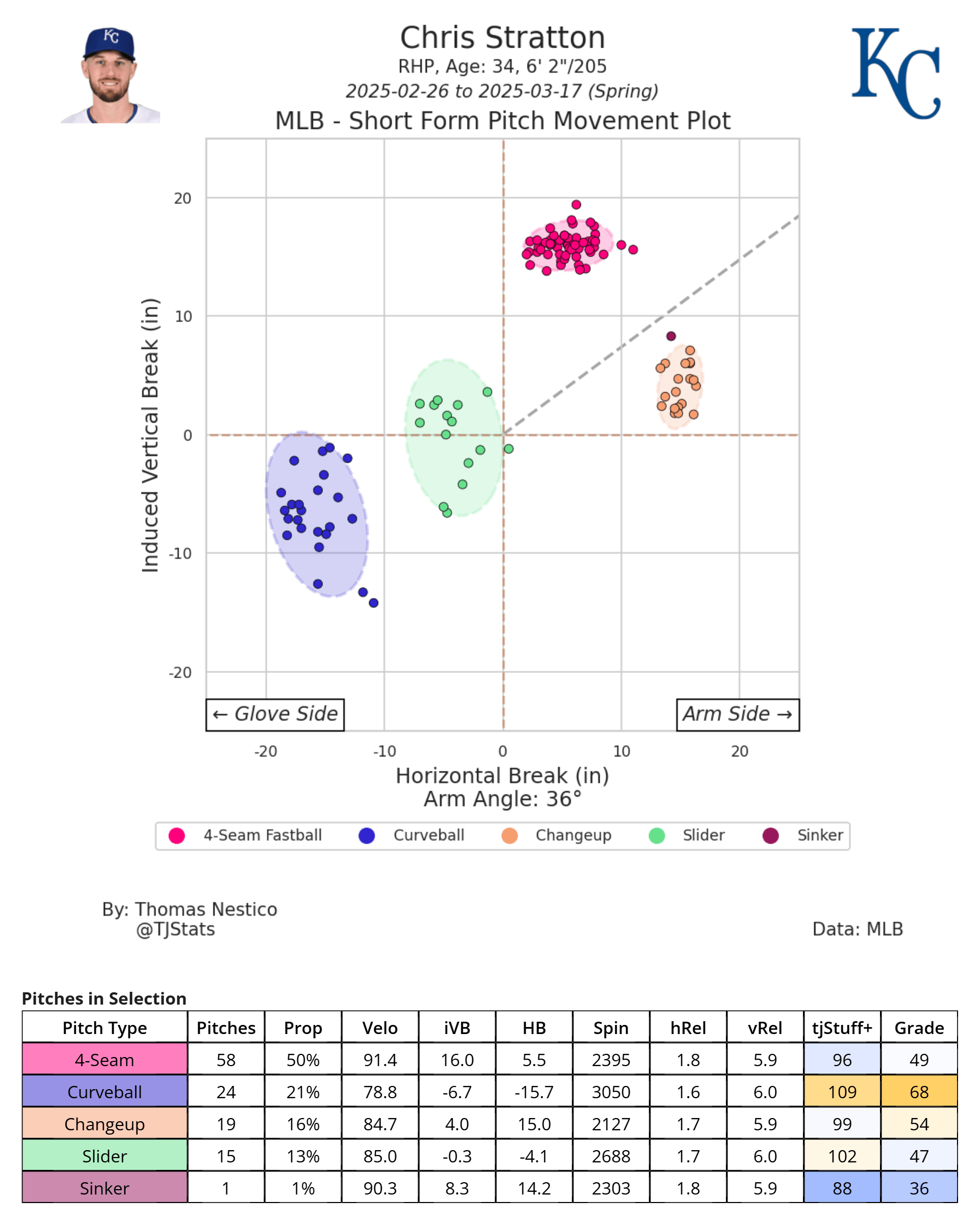
Clarke’s sinker has been his weakest pitch this spring, with a 91 tjStuff+ and 42 grade. However, it’s been better than Stratton’s sinker, which has an 88 tjStuff+ and 36 grade (though he’s only thrown it once). Clarke has also sported a better slider (104 tjStuff+ to 102) and a similar four-seamer (96). Stratton does have a better changeup (96 to Clarke’s 92), and his curveball, his best pitch (109 tjStuff+), rates better than Clarke’s sweeper (106 tjStuff+).
Still, Clarke and Stratton have not had a considerable skill gap this spring. Royals fans may prefer Clarke’s repertoire, as he has three pitches with tjStuff+ over 100 compared to Stratton’s two.
The Royals would have to be okay eating Stratton’s $4.5 million contract this year. That said, if Stratton gets off to a slow start in 2025, Clarke could replace him in the bullpen, and the Royals may see a slight upgrade in Clarke, thanks to his diverse pitch arsenal and groundball-inducing ability.
Photo Credit: Ed Zurga/Getty Images