
Spring Training is less about individual or team success and more about observing players’ adjustments at the plate or on the mound before Opening Day. Cactus or Grapefruit League games are often the initial test ground for changes that players had been working on in the offseason, hoping that those differences will translate to success once the regular season begins.
As expected, a sizable number of Royals players are making adjustments this offseason, hoping that it will translate into success in 2025. In this post, I will look at four of them (two hitters and two pitchers) who are making those adjustments early in Cactus League play to find success this season.
Garcia’s Stance and Balance
Jack Johnson of the “Locked on Royals” podcast pointed out that Maikel Garcia showcased a slight change in hand placement in his stance this spring. While it wasn’t a dramatic shift, it certainly was noticeable from what he demonstrated a season ago.
Garcia is coming off a disappointing season in 2024, as he only hit .231 with a .613 OPS, .270 wOBA, and .300 xwOBA. After hitting in the leadoff spot for most of last season, he likely will bat down in the batting order after the Royals acquired Jonathan India this offseason.
Even though his role in the line has changed, the Royals need Garcia to bounce back with his bat if they hope to improve upon their 86-76 record last year.
The hand placement could help Garcia improve his bat speed, which ranked in the 30th percentile last season via Savant. Despite this slow bat speed, the Venezuelan infielder has shown an uncanny ability to square up the ball over the past two seasons, which demonstrates the upside he carries as a hitter long-term.

Even though he saw slight regressions in squared-up and blast percentage from 2023, he still ranked in the 98th percentile in squared-up rate in 2024. He did show a slight tick-up in bat speed in 2024 from his rookie year, as his average bat speed went up one MPH, and his fast-swing rate went up 5.8%. It’s possible that the hand placement could help him continue to improve his bat speed, which in turn could help him maintain high squared-up and blast rates in 2025.
There’s no question that Garcia can hit the ball hard. However, his inconsistent balance in his swings last year led to inconsistent production. Royals hitting coach Alec Zumwalt identified this inconsistent balance as “crashing.” In a recent piece by Anne Rogers, Zumwalt talked about Garcia working on minimizing that in 2025.
Here’s what Zumwalt said in the article:
“Crashing, for us, is when the foot gets down and everything is coming behind it with no ability to stop,” Zumwalt said. “So you’re basically in ‘go’ mode, and it’s really hard to adjust. If you guess right, it looks good. You guess wrong, you miss. With Maikel, what gives him so much hitting ability is he’s got such a flat swing through the zone, so he can be a little late and shoot the ball the other way.
“But we’ve talked about getting away from the crashing. He owned it. He felt his weight get too heavy on the front foot and knew he needed to be more adjustable. … Just selling out to be a good hitter. He knows that’s in his DNA. He knows that’s what he’s good at.”
Below is an example of Garcia “crashing” in his swing against Boston’s Cam Booser in an August 5th game at Kauffman Stadium. That causes him to overswing on the pitch (a cutter), which leads to an easy groundout.
Garcia improved his contact ability in his sophomore season in 2024. He lowered his whiff rate from 19.5% in 2023 to 15.7% in 2024 despite swinging roughly the same amount in 2024 (43.4%) as in 2023 (43.1%). That said, he traded contact for bad swings, as he seemed to sell out too often at times to make contact on pitches that produced easy fielding outs.
By working on maintaining more balance in his swing, which seems to be his goal this spring, Garcia may be able to make more “productive” contact. That should lead to better results at the plate in 2025.
Melendez Minimized Leg Kick
There’s no question that this will be a “make or break” season for MJ Melendez as he enters his age-26 season. Last season, Melendez hit 17 home runs, but he only posted a .206 average, .673 OPS, .292 wOBA, and .317 xwOBA. Those latter four categories were all career-worsts for the 2017 second-round pick.
After a sub-par 2024 campaign, Melendez has made considerable changes to his swing, particularly regarding his leg kick.
In his first three seasons, the Royals outfielder demonstrated a pretty big leg kick at the plate, contributing to his above-average bat speed (66th percentile) and tapping into his power tool (74th percentile hard-hit rate). When it all clicked, the leg kick led to big home runs, like this one against Angels starter (and former Royals postseason hero) Johnny Cueto.
Conversely, the big leg kick made him susceptible to whiffing at the plate.
His whiff rate ranked in the 21st percentile last season via Savant. He has been awful against breaking balls the past two seasons, as he sported a whiff rate of 37.4% in 2024 and 35.4% in 2023 against breaking offerings. His batting average the past two years against breaking balls has been .198 and .172 in 2024 and 2023, respectively.
Melendez is trading the big right leg kick this spring for a more nuanced one, as illustrated in the video comparison below via Rogers.
Below is what assistant hitting coach Keoni DeRenne said about Melendez’s leg kick in an article from Rogers this spring and why the big leg kick led to other issues with his timing at the plate.
“Because he had his hands in front of him, it would travel, travel, travel back, along with the big leg kick,” assistant hitting coach Keoni DeRenne said. “Now all these moves, when you have [velocity], it’s hard to time up, [especially] because of the separation of the offspeed pitches.
“Timing, rhythm, balance is so important to be a successful hitter. And it’s hard when we don’t know what’s coming at us. MJ, because of the hyper-mobility he has, he can be in awkward positions and still be able to get the barrel to the ball, which is what we’ve seen over time. But at the same time, it sometimes works against him. Maybe the zone expands, and you’re thinking, ‘I can get to that pitch because of the way I move, I can find a way or a solution to get to that pitch.’ … He’s got to be able to use the lower half to anchor himself. When he takes pitches and he’s not moving around, I know he’s in a good spot.”
So far, MJ’s early results have been harsh. He is 0-for-5 with four strikeouts in two Cactus League games. He was particularly overwhelmed by the fastball today against the Athletics, as evidenced by an 80% whiff rate on the pitch.

Thus, seeing how patient Melendez stays with this new swing will be interesting, especially as we get closer to Opening Day. While Melendez’s spot on the Opening Day roster is safe, he may not get as much patience from manager Matt Quatraro if he struggles out of the gate again in 2025.
Ragans’ Increased Four-Seam Velocity
Cole Ragans had a dominant 2024 as he finished fourth in the AL Cy Young race thanks to a 3.14 ERA and 1.14 WHIP in 32 starts and 186.1 IP. A minor concern with Ragans was his slight regression in four-seam velocity, from 96.5 MPH in 2023 to 95.4 MPH in 2024.

As a result, his whiff rate on the four-seamer went from 27.9% in 2023 to 23.2% in 2024. While those are still impressive numbers, how Ragans’ fastball velocity would fare in 2025 is clearly on the minds of many baseball fans this offseason, especially with Ragans’ injury history (two Tommy John surgeries).
Thankfully, Ragans’ fastball velocity and stuff were in mid-season form in his Cactus League debut on Monday against the Athletics.

Ragans threw his four-seamer 17 times, suitable for a 50% usage rate. The pitch averaged 96.9 MPH, 1.5 MPH higher than his average a year ago. Furthermore, it sported a 104 tjStuff+ and 60 grade via TJ Stats. It didn’t generate many whiffs (11.1%) or strikes (35.3% zone rate), but considering it was his first Cactus League game, those growing pains with control were to be expected.
The lefty’s arsenal as a whole impressed on Monday.
He posted an overall tjStuff+ over 105, with his cutter producing the best tjStuff+ mark at 110. Ragans didn’t have one pitch below 103 on a tjStuff+ end, demonstrating that the 26-year-old Royals ace was amped and ready to go in his first outing of 2025.
His fastball velocity will be worth paying attention to in future starts this spring. If it continues to be 96+ MPH, then it isn’t out of the question to think that Ragans could compete with Tarik Skubal for the AL Cy Young this season.
Avila’s Curveball Development
Luinder Avila is likely a longshot to make the Royals’ Opening Day roster, especially with Carlos Hernandez and Chris Stratton needing to make it to stay on the 40-man roster (they don’t have any Minor League options and would have to be designated for assignment if they don’t make the active roster). However, the recently added reliever certainly impressed in his Cactus League debut against the Athletics.
Avila threw straight gas and filth on Monday, producing two strikeouts, one walk, and no hits or runs allowed in two innings. Furthermore, the 23-year-old Venezuelan’s arsenal rated well in his Spring Training debut via TJ Stats Spring Training pitch plot data.
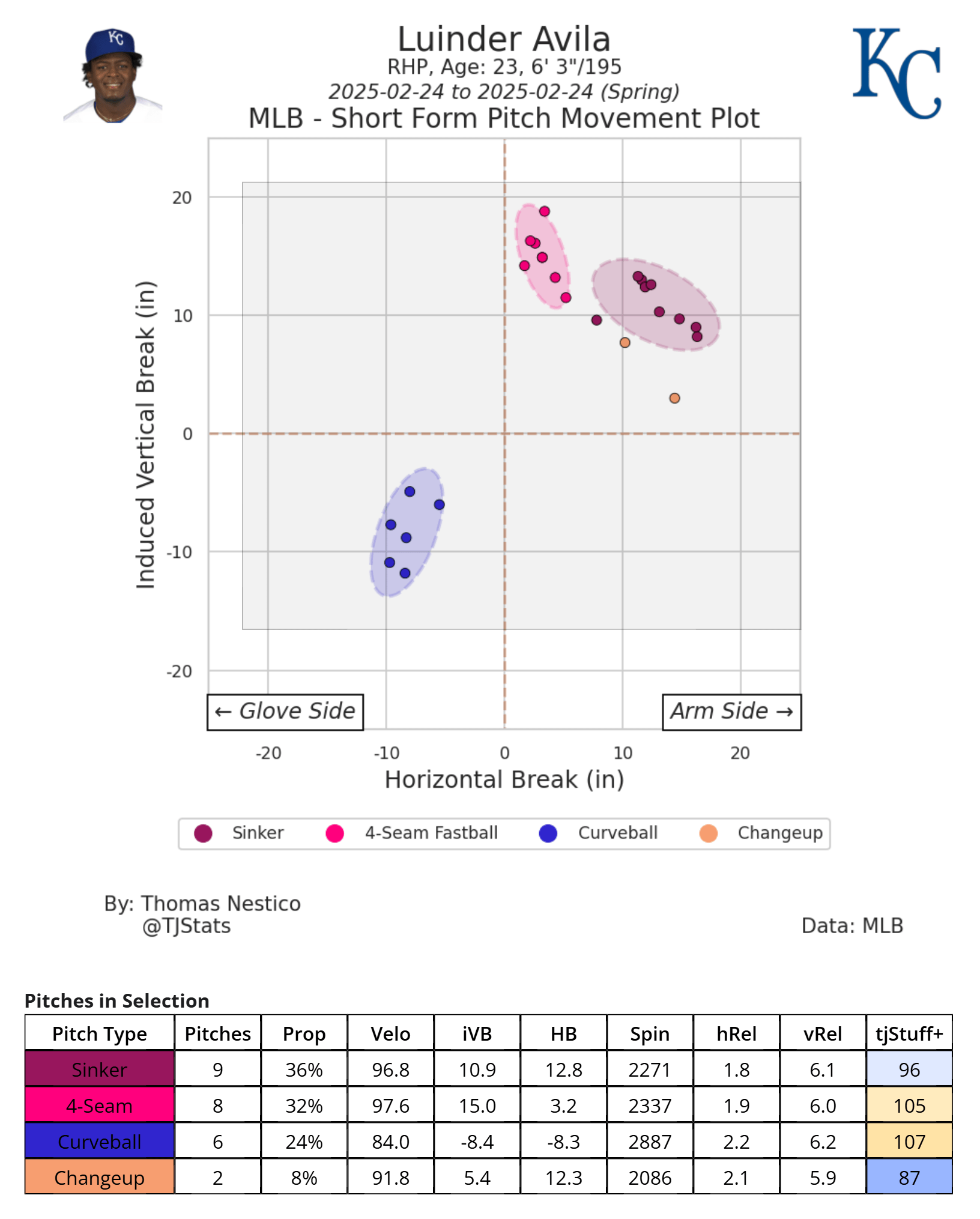
Avila’s four-seamer got plenty of attention on Monday, and rightfully so. It not only averaged 97.6 MPH, but it also sported a 15.0 iVB and 107 tjStuff+. Conversely, I was more impressed with his curveball, which had a 107 tjStuff+ and a spin rate of 2,887 RPM. That is some insane movement from a breaking offering.
We saw seeds of success with that curve last year from Avila in Northwest Arkansas, as he opted to utilize that pitch as his primary breaking offering over the slider, which he used more often previously in his career.
The curve on Monday not only demonstrated excellent movement via tjStuff+ data but also produced eye-popping results.
The curve had a zone rate of 50%, a chase rate of 66.7%, and a whiff rate of 100%. It’s a small sample, but Avila’s outing on Monday showed that his breaking ball could be one of the most dominant offerings in the Royals bullpen when utilized correctly.

Avila’s four-seamer and sinker lit up the radar guns and initially captured the Royals’ fans’ attention today on social media.
That said, how his curve continues to develop in terms of stuff and command could be the key to when the Royals call up Avila this season. If it continues to play in the future like it did today, Avila may be in the Royals bullpen sooner rather than later.
Photo Credit: AP Photo/Colin E. Braley