
At 17-39, the Royals are clearly in an “evaluation” season where they are determining who will be long-term pieces worth building around beyond 2023.
In some cases, the “extension” choices are pretty obvious for JJ Picollo and the Royals front office.
Vinnie Pasquantino should be a long-term piece worth building around, and it sounds like both the Royals and Pasquantino are interested in making that happen sometime soon.
Bobby Witt, Jr. is also another candidate, even though his situation is more complicated than Vinnie’s.
Witt’s triple slash (.228/.260/.430) is not exactly impressive, and his 84 wRC+ doesn’t necessarily inspire a Royals fanbase that was looking forward to him taking a step toward stardom in his second MLB season. That was certainly displayed in this poll shared by Alex Duvall of Royals Farm Report today.
That said, Witt is still on pace for nearly 30 homers and over 40 bases this season, and it’s likely that once he gets in a groove, his slash line and wRC+ metrics will improve. If he can see significant gain in those categories, then it’s likely that Witt will not only be a possible perennial All-Star but one worthy of an expensive long-term extension. Picollo and the Royals front office have certainly mentioned before as a possibility in the past.
One of the more complicated pieces of this young group though may be MJ Melendez, the former 2017 2nd-round pick who hit 18 home runs in 129 games in his rookie season, but only posted a 99 wRC+ and -0.2 fWAR, according to Fangraphs.
There’s no question that Melendez has the talent and toolset to be a player worth building around long-term for this club. That said, he still showcases some concerning flaws that make him a wild card not worth fully trusting just yet.
Let’s take a dive into what Melendez brings to the table to this Royals team in the long term, and what issues could perhaps make him expendable in Kansas City.
Melendez’s Power Improvement in 2023
Melendez’s line this season hasn’t been eye-popping by any measure, which is what makes his situation so difficult for Royals fans to evaluate.
In 51 games and 212 plate appearances, Melendez is slashing .205/.297/.362 with five home runs, 23 RBI, and a wRC+ of 80. The meager home run total, and .157 ISO, which is 19 points lower than a season ago, don’t give Royals fans hope that Melendez’s power has developed all that much in 2023.
On the other hand, Melendez’s batted ball metrics demonstrate that his power this year is certainly maturing, even if it hasn’t shown in the surface-level numbers.
Here’s a look at Melendez’s batted ball metrics over the past two years, via Pitcher List. Notice the stark increases in nearly every category from his rookie season.

Not only has Melendez improved in nearly every batted-ball category from his rookie campaign, but he’s been in the upper percentiles of the league in those categories as well.
Melendez is currently in the 100th percentile in solid contact percentage; 86th percentile in barrel rate; 98th percentile in ideal-contact rate; and 98th percentile in average exit velocity. Furthermore, he also is near the top of every power-related Statcast metric as well, according to Fangraphs.

When Melendez makes contact with the ball, it is hit with authority and typically does damage, much like this home run on Sunday on a 95 MPH four-seamer from Nationals starter MacKenzie Gore.
Those power traits from Melendez certainly aren’t common to see and develop within any organization, let alone the Royals.
And on a positive note, it seems like Melendez’s power on a PLV end has begun to bounce back a bit after a slightly rough stretch for a period of plate appearances.

After dipping slightly below the MLB average in terms of expected extra bases added, Melendez has jumped back up over the 75th percentile, and his season average continues to be around the 90th percentile as well.
If the Royals are looking for a long-term bat to provide power production in the middle of the order, the 24-year-old Melendez should fit the bill for a possible long-term extension.
Melendez’s Whiff and Contact Issues
Last season, Melendez showcased an excellent eye at the plate, as he not only walked 12.4 percent of the time but also produced a BB/K ratio of 0.50. That ratio was the fourth-best mark on the team last year behind Carlos Santana, Vinnie, and Andrew Benintendi, according to Fangraphs.
Thus, it’s not surprising that Melendez saw some time at the leadoff spot a season ago and was considered for the spot back in Spring Training.
This year, the ratio is not as impressive, as it has dipped to 0.36 for the season thus far. That being said, he is still producing an 11.3 percent walk rate, and his decision value metrics also display that he’s getting better in his choices at the plate after a slow start.

Melendez shows a patient approach at the plate and can lay off bad pitches for the most part. His 31.1 percent O-Swing% is the fourth-lowest mark on the team, behind only Maikel Garcia, Nick Pratto, and Nicky Lopez, according to Fangraphs.
While Melendez does not chase as often as his Royals peers, his struggles with whiffs and consistent contact is a huge area of concern that is contributing heavily to his 31.1 percent K rate, which is 6.6 percent higher than a season ago.
Here’s a look at Melendez’s contact ability PLV this season, and notice how his rolling chart data has primarily sat below the 25th percentile of the league so far in 2023:

Now, Royals fans may be thinking: Melendez isn’t chasing too much out of the zone, so why is he whiffing and striking out so much at the plate?
A big issue is that he is struggling to make consistent contact on swings on pitches thrown in the strike zone, which is evident in his Z-Contact%.
Melendez is currently generating a Z-Contact% of 73.3 percent this year, which is not only 12.2 percent below the league average, but also the worst mark for Royals hitters this year with 10 or more plate appearances this season.

If that wasn’t enough, Melendez also sports the 2nd-worst zone contact% of all qualified MLB hitters this season. His percentage is only better than Atlanta’s Matt Olson, who possesses a 72 percent zone contact%, according to Fangraphs.

A big contributor to this problem for Melendez has been his struggles to consistently catch up with fastballs this season. Notice in the graph below how his in-zone swing and miss rate has gone from slightly above 20 percent in 2022 to well over 30 percent in 2023.

Furthermore, let’s take a look at the difference in his overall performance against fastball pitches this season versus a season ago as well, via Savant.

An at-bat that encapsulates Melendez’s struggles against the four-seamer is this recent strikeout on May 23rd against Detroit’s Will Vest at Kauffman Stadium.
Vest pumps his four-seamer down in the zone at 95 MPH. Unfortunately for the Royals, he catches an obviously unprepared Melendez who guesses wrong on a 2-2 count (he’s obviously looking offspeed) and isn’t able to adjust quickly enough to make contact.
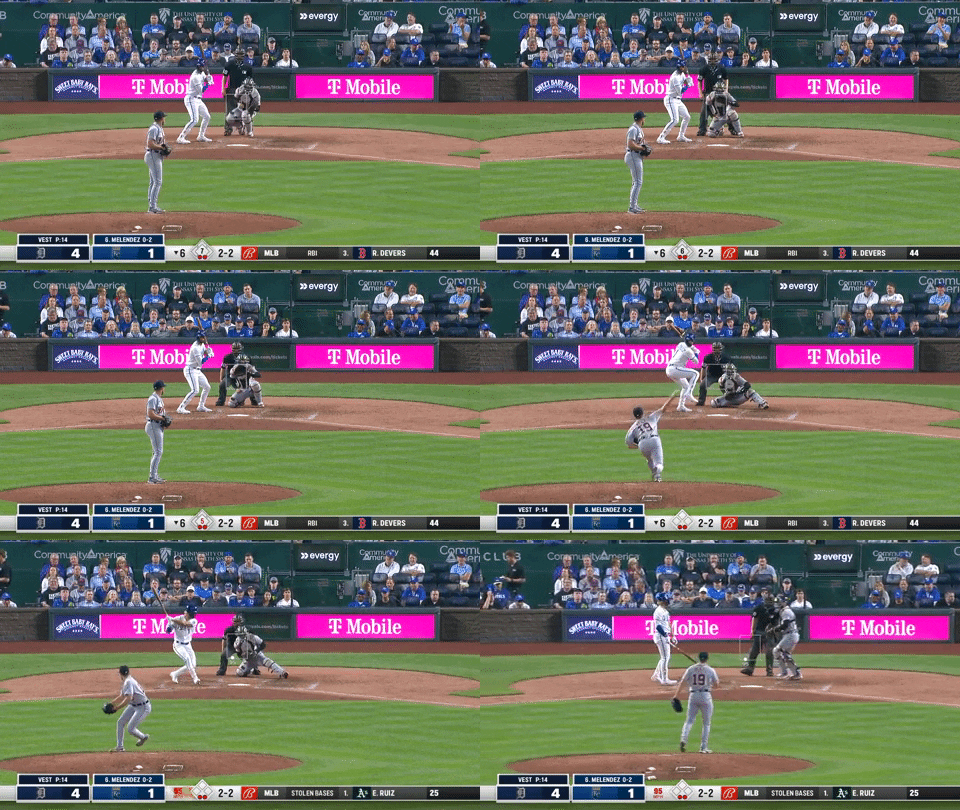
Incredibly, Melendez is actually hitting fastballs harder than a year ago when he does make contact. His .522 xSLG is a 42-point improvement on that mark from his rookie year, and his average exit velocity on batted fastballs is up by 2.3 MPH from 2022 as well.
However, that batted ball velocity will struggle to matter if Melendez continues to have issues making contact on pitches inside the strike zone going forward this season and beyond.
Is Melendez A Long-Term Piece For the Royals?
As a Royals fan, I am really torn on Melendez.
On one end, his power potential is tantalizing, even for a corner outfielder who just transitioned to the position full-time recently.
Granted, his defense in the outfield hasn’t made the gains one would’ve hoped after a full off-season training in the outfield, but it still isn’t bad by any means. He’s been worth -1 OAA this year in right field, according to Savant, but he has shown decent range, which can be seen in this OAA ending position chart below:

There’s no question to think that with more work in the outfield, Melendez at the very least could be an average or slightly above right fielder in the next year or two, especially with his natural athleticism.
That said, his swing-and-miss issues are a concern, especially considering the fact that those whiffs aren’t on chases out of the zone but rather pitches INSIDE the strike zone. This wasn’t as bad an issue a season ago, as his Z-Contact rate was 79.3 percent a year ago, which was still below average but not as dramatic.
Is this just a bad stretch and with further continued adjustments, could Melendez turn it around, much like he did after a rough start to the season? His splits in May were already considerably better than his ones in April, and that’s with the continued in-zone whiff issues.

Melendez needs to make an adjustment this next month or two to address these contact problems. No Royals fan is expecting him to be a league-average contact hitter. As a power hitter, there has to be some tradeoff, as is the case with a majority of hitters who rely on their power tool to find success. Melendez’s power tool could be quite special both this season and beyond.
In fact, his profile does mirror Seattle’s Jarred Kelenic, who has had a breakout this year after some initial struggles the past two years.


Despite that promising comparison to Kelenic, a 31.1 percent K rate and a sub-75 percent Z-Contact rate are not a combination for success.
Melendez not improving upon those issues in some kind of fashion will not only limit his upside but his outlook in Kansas City. Even non-Royals baseball fans, especially in the fantasy world, are showing their skepticism about Melendez’s future.
It will be an interesting June and July for Melendez.
An improvement in those areas could mean a possible long-term investment this winter.
Failure to do so could make him a trade piece by the July Deadline, especially for an organization that needs to restock its pitching in the upper levels of the farm system.
Photo Credit: Jay Biggerstaff-USA TODAY Sports
Mr. O’B, I really, really appreciate these deep dives you take; I am far too dense to find this stuff out on my own. I know it puts a smile on my face when I see MJ go oppo. And I shake my head when I see Witt swing wildly and make Salvy look utterly plate-disciplined.
Thanks Terry! I do like that MJ is more prone to go oppo than BWJ and Salvy. That said, I am concerned by how many pitches he whiffs on in the zone. That’s not a good long-term sign. Then again, he did make steady improvement from April to May, so I’m hope that he will continue that upwrd progression from May to June.
[…] MJ certainly has the raw batted-ball tools to fill that role, as his hard-hit metrics this season put him in pretty impressive company around the league. […]
[…] Unfortunately, Melendez struggled at the plate in the first half of the season, and as a result, Royals fans began to wonder if Melendez would be part of the Royals’ next winning core. […]
[…] Perez, who’s been tied to the Marlins and White Sox organizations previously, MJ Melendez, who still has intriguing potential, or Maikel Garcia, who had a promising rookie season and is off to another scorching start in the […]